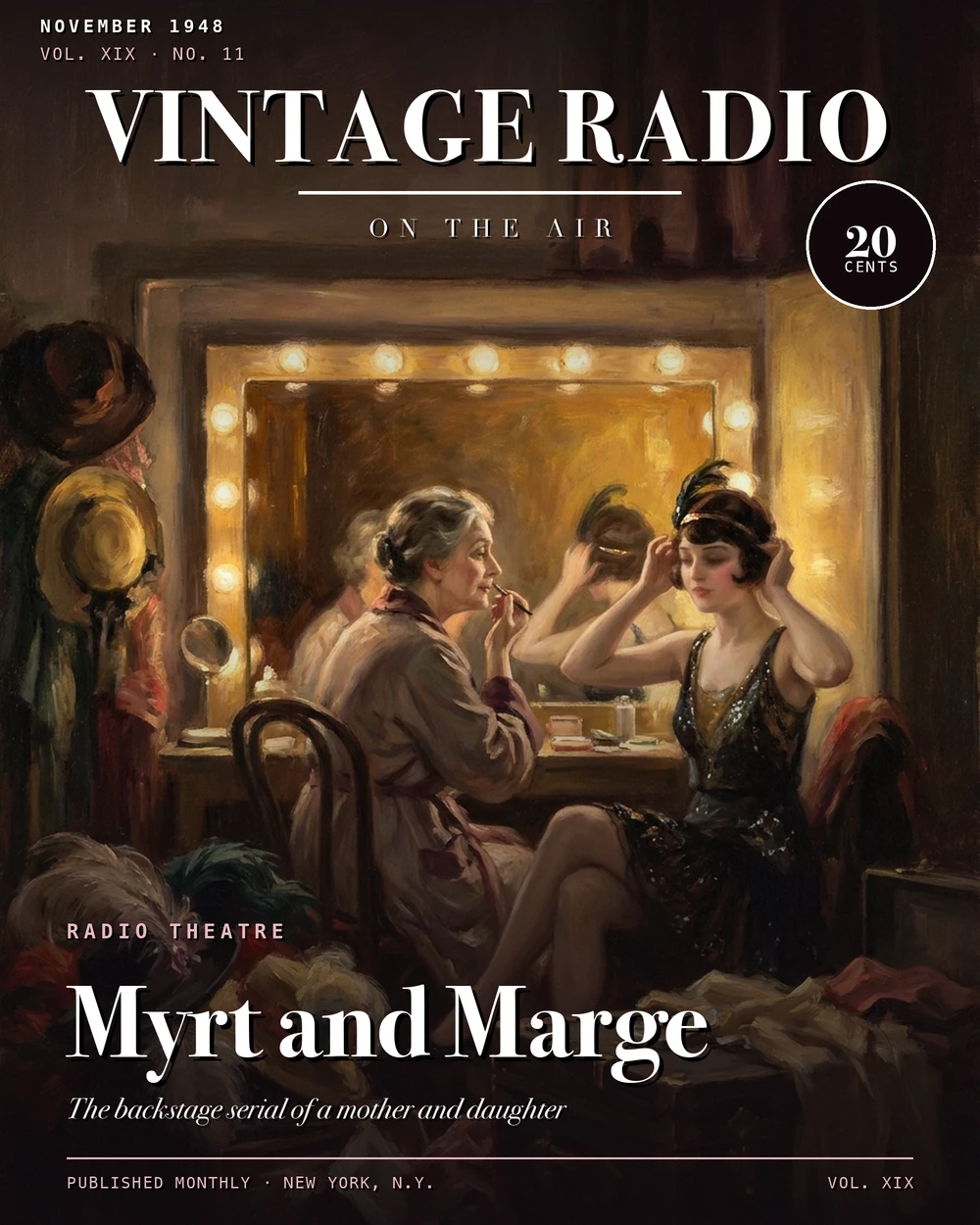
Myrt and Marge
How It Came to Be
The origin story of Myrt and Marge is one of the more remarkable in radio history. Myrtle Vail was 43 years old, a veteran vaudevillian who had spent decades on the road with her husband and children, when the 1929 market crash wiped out the real estate money the family had put aside for retirement. Facing financial ruin, she looked at the new medium of radio and saw a way back. What she invented became one of the first important dramatic serials in broadcasting.
By 43, Vail had a long stage life behind her. At about 17 she had joined the chorus of Ned Washburn's production The Umpire — the chorus girls were called "broilers" — and that was her professional stage debut. The tenor lead was George Damerel, and she married him in 1907. They worked the Orpheum and Keith circuits as Damerel & Vail & Co. until vaudeville's decline in the mid-1920s; in 1924 the act was renamed "The Three of Us" when daughter Donna joined her parents onstage. The family settled in Chicago, where George moved into real estate, and the 1929 crash undid all of it.
The idea, as legend has it, came to her as she reached for a stick of gum. The Wrigley Company was Chicago-based, nationally prominent, and — as Vail discovered — had put no money into radio advertising at the time. So she designed her serial specifically to appeal to them. Her two main characters were Myrtle Spear and Margie Minter, the names a deliberate nod to spearmint. She dashed off ten scripts in longhand, pitched the concept, and ten days later the show was on the air. She had never faced a microphone before she sat down to play Myrt.
Her daughter Donna Damerel, 19 years old, played Marge. This was not casting by convenience — the real-life relationship between Vail and Damerel was the engine of the show. The premise had Myrt and Marge meeting as strangers in Hayfield's Theater and slowly discovering they were mother and daughter. Art and life were wound together from the first broadcast, on November 2, 1931.
The World of the Show
The setting was the chorus line of Hayfield's Pleasures, a Broadway revue featuring a 24-girl precision troupe called the Chic-Chicks. Myrt was the seasoned pro; Marge was the young newcomer who fainted from hunger on her first day, prompting Myrt to borrow a "five-spot" and send out for a meal. The show was billed as "the world of the theater and the world of life, and the story of two women who seek fame in the one and contentment in the other."
Those were the romantic trappings, but Myrt and Marge had a harder edge than that billing suggested. The early storylines were full of gangsters, racketeers, and bootleggers — the show went to South America in 1934 and ranged from Broadway to theatrical boondocks and back. A critic writing in The Forum praised it as "the most advanced program of its type now on the air," calling the two heroines easy to take "like honey and cream" while noting the setting was "hard and glittering" with lines "swift and direct." The gangster element, that critic observed, led to "infinite variations never before done in a serialized 15-minute period."
In its first year, running opposite Amos 'n' Andy at 7 p.m. on CBS, the show leaped to a CAB rating in the mid-20s by 1932. A 1931 trade publication described the cast as "one of the largest casts in radio," reporting that thirty actors and musicians took part in most presentations, with no actor playing a double role. A 1932 radio magazine poll named Donna Damerel radio's "it girl," with 15,704 listeners participating in the vote, recognizing her looks, microphone personality, and voice.
The characters were allowed to age over the run. Marge, who was 16 when the story began, eventually married lawyer Jack Arnold, became mother to Baby Midgie in 1935, and was widowed when Jack was killed off in 1937. Myrt married Francis Hayfield — a character who bore more than a passing resemblance to Florenz Ziegfeld — and was widowed in 1936 when Hayfield died. After the Pleasures show closed, the two women traveled through Hollywood and the Midwest in a road company before returning to New York with plans to reopen the theater and mount a new Pleasures revue.
The supporting cast included a range of comic and dramatic characters that became fixtures over the years. Ray Hedge played Clarence Tiffingtuffer, a fussy costume designer used mainly as a worrywart for comic relief — Radioland magazine described the character as a "thi-thy," though he did not actually lisp. Cliff Arquette played the other comic role, Thaddeus Comfelder. Santos Ortega and Dick Janaver both played Lee Kirby, a suitor of Marge. Edith Evanson played Helmi, the faithful maid who had weathered so many of Myrt and Marge's experiences with them, and who sang "Yingle Bells" endlessly each Christmas. Sunda Love played Leota Lawrence, described for a time as the show's "archvillainess." The theme music was "Poor Butterfly," which stood out on the daytime air with a haunting, distinctive quality.
The Move to Daytime and the Sponsor Story
When the show shifted from its 7 p.m. weeknight slot to a 10:15 a.m. daytime slot on January 4, 1937, it became a soap opera in more than format — it picked up Super Suds as its sponsor, a product of Colgate-Palmolive-Peet, and settled into the daily domestic rhythm of daytime serial radio. Wrigley's had carried the evening run from 1931 to 1937; Colgate-Palmolive-Peet took over for the final five years. The show also ran simultaneously on Mutual from March to October 1939 in an afternoon slot.
The shift to daytime coincided with story changes that reflected the new context. Jack Arnold, previously a young lawyer with romantic storylines, took a position with District Attorney Dunham, which brought new gangster and racketeer plots into the show before his death ended that thread entirely. The show's innovations were being absorbed and refined by competitors, and Myrt and Marge gradually lost ground in the ratings through the late 1930s.
In 1933, Vail had been seriously injured in a car accident. She handed the writing to a colleague named Charles Thomas, who devised a storyline in which Myrt was kidnapped by gangsters — a tidy solution that kept the character present in the story while the actress recovered. Vail shared writing credit with Cliff Thomas throughout the run.
The 1934 Film and What It Captured
Universal Studios released a Myrt and Marge feature film in 1933, directed by Al Boasberg — a comedy writer best known for his work with Jack Benny, the Marx Brothers (including A Night at the Opera), and Buster Keaton (The General). It was both his feature film directing debut and his only one; he died of a heart attack in 1937 at 45. Vail and Damerel played their radio roles; Ray Hedge reprised Clarence Tiffingtuffer; and the cast included Eddie Foy Jr., Ted Healy, and his three stooges — Moe Howard, Larry Fine, and Curly Howard — shortly before that trio split from Healy to form the Three Stooges independently. The film was a box office disappointment for Universal.
The vaudeville circuit also got a version of Myrt and Marge during the summers when the radio show was off the air. Vail and Damerel toured the Orpheum and Keith circuits, working dramatic Myrt and Marge skits into their act — their real family history repurposed again as performance.
Donna Damerel's Death and What Followed
Donna Damerel had been born in Chicago on July 8, 1912, and her life had paralleled her mother's in striking ways. Like Vail, she had left home at 15 to join the chorus of a musical comedy, and from there she joined her parents' vaudeville team. By her late twenties she had been married twice before her marriage to swimmer Peter Fick; one of her sons from those earlier marriages was Charles B. Griffith, who would grow up to be a screenwriter and would later write the Roger Corman films his grandmother appeared in.
On February 15, 1941, Damerel died moments after giving birth to her third child at Englewood Hospital in New Jersey. She was 28 years old. She had performed on the show hours before going into labor. The baby survived. George Damerel, her father, had died five years earlier in 1936; Vail apparently never remarried.
Vail was quoted in Movie-Radio Guide as saying she believed her daughter would not have wanted the show to die. Colgate-Palmolive-Peet interviewed 200 possible replacements for the role of Marge, paraded 60 of them before Vail, and allowed her to reduce the list to 35. Auditions were held over three days at CBS studios. The unanimous choice was Helen Mack, a film actress with credits that included The Son of Kong (1933), The Milky Way (1936), and His Girl Friday (1940). Mack had moved toward radio work partly because her second husband, Tom McAvity, was a radio executive with the ad agency Lord and Thomas.
The show continued with Mack in the role through March 27, 1942, when it ended its network run. After Myrt and Marge, Mack moved into production and direction, overseeing Richard Diamond, Private Detective, The Saint, Meet Corliss Archer, and A Date with Judy. Radio Life magazine gave her a Distinguished Achievement Award in 1946 for her directing work on A Date with Judy and Beulah.
After the Run
Vail attempted a spin-off called Myrt, Ltd. after the show ended in 1942; it did not find an audience. In 1946, a syndicated revival was produced by WOR, with Vail updating the original scripts to replace the 1930s bootleggers with postwar black marketeers. Alice Yourman played Myrt in the revival, Alice Goodkin played Marge, and Vinton Hayworth and Ray Hedge returned to their original roles. The transcriptions were still running on some CBS stations as late as September 1947. A television pilot made in 1949 did not sell.
In her later years, Vail appeared in two Roger Corman films written by her grandson Charles B. Griffith — A Bucket of Blood (1959) and The Little Shop of Horrors (1960) — and made an appearance on television's This Is Your Life in 1960. She had outlived her daughter by nearly four decades when she died on September 18, 1978, in Kansas City, Missouri, at the age of 90. She had been born in Joliet, Illinois, on January 7, 1888, and spent almost the whole of that long life in show business of one kind or another.
A note on what survives. For a show that ran more than a decade and helped define the daytime serial form, Myrt and Marge is curiously inaccessible today. Roughly 110 to 112 episodes survive in audio form, but the overwhelming majority come from the 1946–47 syndication revival rather than the main network run. Only three episodes from the 1930s are known to exist, including the pilot; before 1937, only a pair of audition recordings have surfaced. The result is that even devoted OTR listeners tend to know the show through its postwar transcriptions, with the prime-time and Wrigley-sponsored years that made its reputation almost entirely lost to the ear.